Interested in this research?
For academic inquiries, collaborations, consulting, or speaking invitations, please contact me directly by email or LinkedIn.
For academic inquiries, collaborations, consulting, or speaking invitations, please contact me directly by email or LinkedIn.
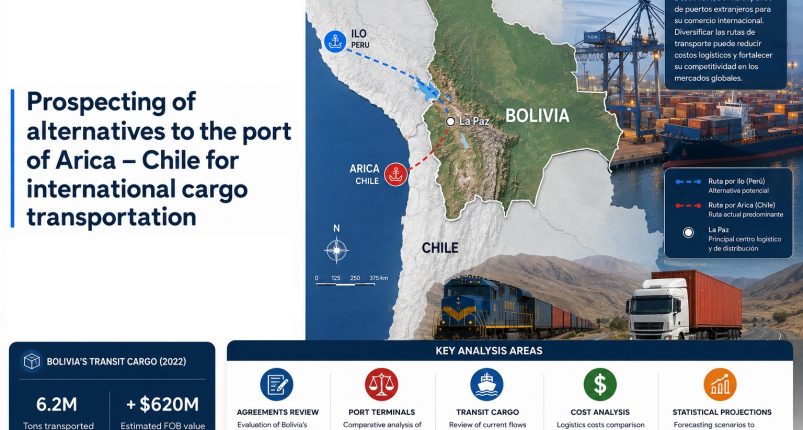
This research explores Bolivia’s dependence on maritime transport through the port of Arica, Chile, and evaluates alternative routes for international cargo movement through South Pacific ports. The study compares port terminals, transit cargo flows, logistics costs and international agreements with Chile and Peru to identify feasible options for improving Bolivia’s foreign trade connectivity.
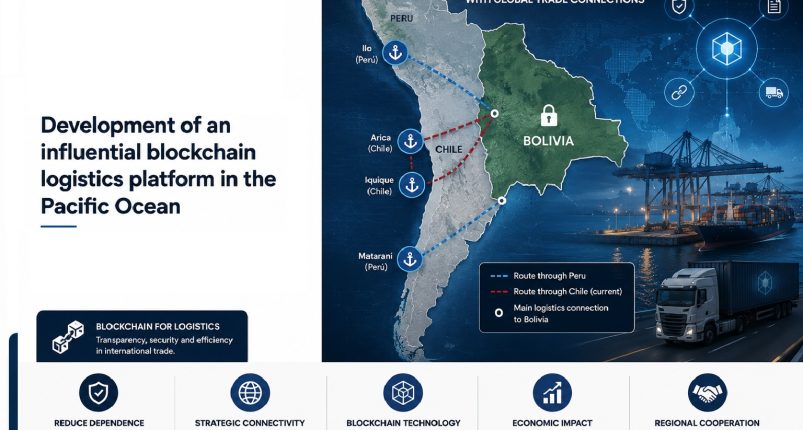
This project proposes the development of a blockchain-based logistics platform to improve Bolivia’s international cargo transportation through Pacific ports. The research analyzes Bolivia’s dependence on Chilean ports, especially Arica and Iquique, and explores alternative routes through Peruvian ports such as Ilo and Matarani.
The proposal focuses on using blockchain technology to increase transparency, traceability and security in logistics operations, allowing better control of cargo flows, port documentation, transit times and trade route performance. The platform aims to support smarter decision-making, reduce dependence on a single route and strengthen Bolivia’s access to global markets
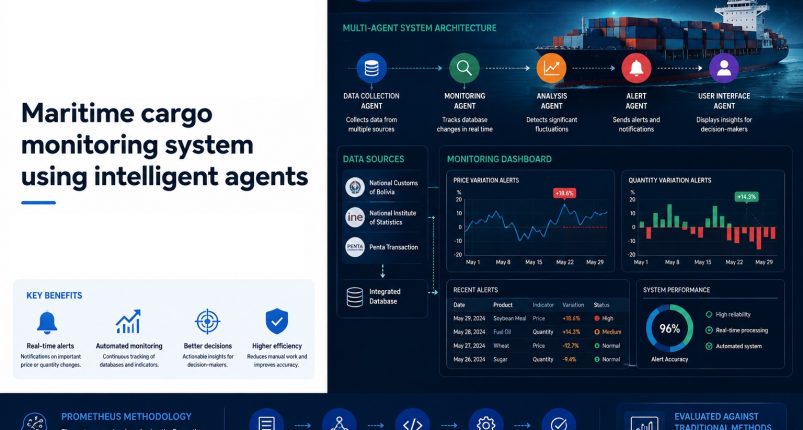
This research presents a multi-agent system designed to monitor Bolivia’s maritime cargo information and support decision-making for international trade and logistics. The system uses intelligent agents to track changes in databases, identify significant variations in prices and quantities, and generate alerts for users when relevant fluctuations occur.
The project was developed using the Prometheus methodology for agent-oriented systems. Its data sources include Bolivia’s National Customs, the National Institute of Statistics and Penta Transaction. The system was evaluated against traditional monitoring methods, demonstrating its potential to automate data analysis, reduce manual review and provide timely insights for decision-makers.
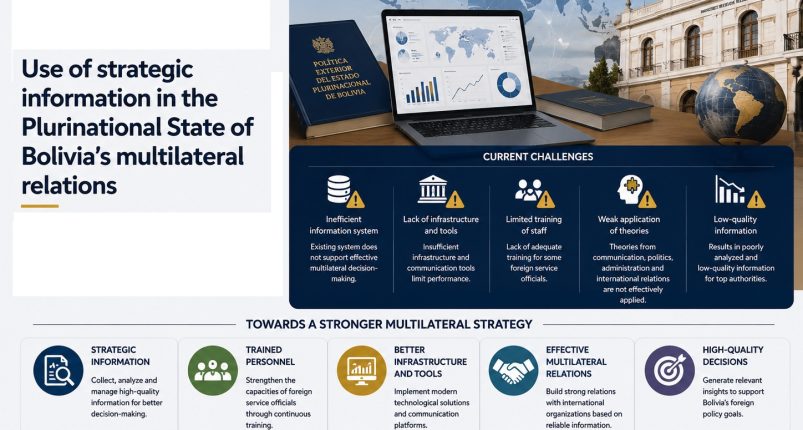
This research analyzes the role of strategic information in strengthening the multilateral relations of the Plurinational State of Bolivia. It examines how information systems, institutional capacity, communication tools and trained personnel influence the quality of decision-making in foreign policy.
The study identifies key challenges such as inefficient information systems, limited infrastructure, weak application of theoretical frameworks and insufficient training for some foreign service officials. It proposes the development of better mechanisms for collecting, analyzing and managing strategic information to support high-level decisions in bilateral and multilateral diplomacy.
© Copyright 2026. All Rights Reserved by Neddy Etman Choque Flores